UNESCO Declares the Act of Going to a Restaurant With Other People an Endangered Cultural Practice. Delivery Apps Named as a Contributing Factor.
The organisation’s emergency session, convened in Paris, heard testimony from fourteen nations. The Italians left to get lunch during the deliberations and have not been formally reprimanded.
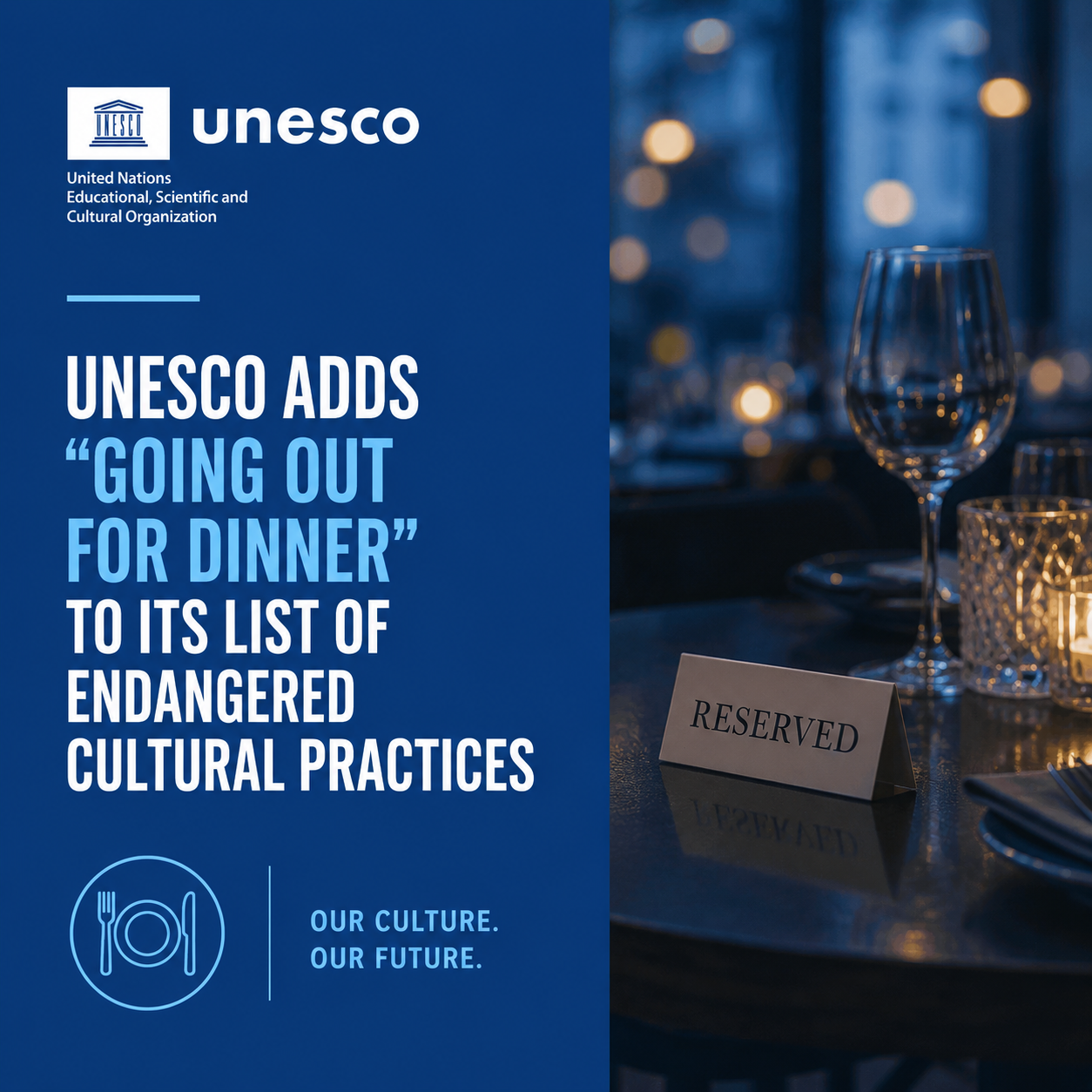
UNESCO, the United Nations cultural heritage organisation responsible for protecting things humanity is in danger of losing, has added “the communal restaurant meal” to its list of endangered intangible cultural practices, joining oral storytelling traditions, ritual dance forms, and the knowledge of how to fold a map.
The listing, which follows a two-year assessment by a working group that ate together approximately forty times during the research period, identifies the communal restaurant meal as a practice under “significant and accelerating threat” from a combination of delivery applications, screen use at the table, and what the report describes as “the general trend toward experiencing food alone in the presence of others.”
The full report, which runs to 340 pages and includes an appendix of photographs of tables where everyone is looking at their phone, defines the communal restaurant meal as: the practice of travelling to a shared location for the purpose of consuming food in the company of other people, with the specific and meaningful intention of talking to those people, in real time, without documentation.
The documentation clause was added following debate. Several member nations argued that photographing food before eating it had become sufficiently widespread to constitute its own cultural practice, and that any attempt to classify it as a threat would be “politically complicated.” The clause was retained. The debate was itself photographed by a delegate and posted before the session concluded.
“What we are observing is the gradual erosion of one of the most persistent and meaningful social rituals in human civilisation. People have been eating together in public since at least ancient Rome. The trajectory has changed.”
— Chair of the Working Group, speaking from a restaurant in Paris where she had just had a very good lunch
Delivery industry representatives, invited to respond, issued a statement describing the listing as “a misunderstanding of consumer preferences” and noting that their platforms had enabled more meals to be eaten than ever before in human history. UNESCO acknowledged this point. The report notes it in a footnote subtitled “Volume vs. Presence.”
The practical implications of the listing are limited. UNESCO’s endangered intangible heritage designations carry no legal weight and involve no enforcement mechanism. Member nations are encouraged to take “appropriate steps to safeguard the practice,” which the report suggests could include public awareness campaigns, school programmes, and “simply going to dinner more often.”
Italy submitted a supplementary statement noting it did not feel the listing applied to it and requested to be listed separately under “thriving.” The request is under review.